AI runs on engineering. We’re teaching it
«The teams that master AI today are the ones who understand it deeply enough to build with it. That conviction is exactly what gave birth to the CactAI Excellence Program.« – Bram Van Nieuwerburgh, CEO at Cactus.
Building true AI fluency in engineering
Across the software industry, a familiar pattern has emerged: developers adopt AI tools, learn the prompts that work, the shortcuts that save time, but they rarely develop a deep, structural understanding of what’s actually happening beneath the surface.
At Cactus, we saw this pattern early and made a deliberate choice: we wouldn’t settle for a team of AI users. We’d build a team of AI-fluent engineers, people who understand transformers and embeddings as well as they understand APIs and databases; people who can architect LLM integrations, evaluate outputs, and govern AI responsibly.
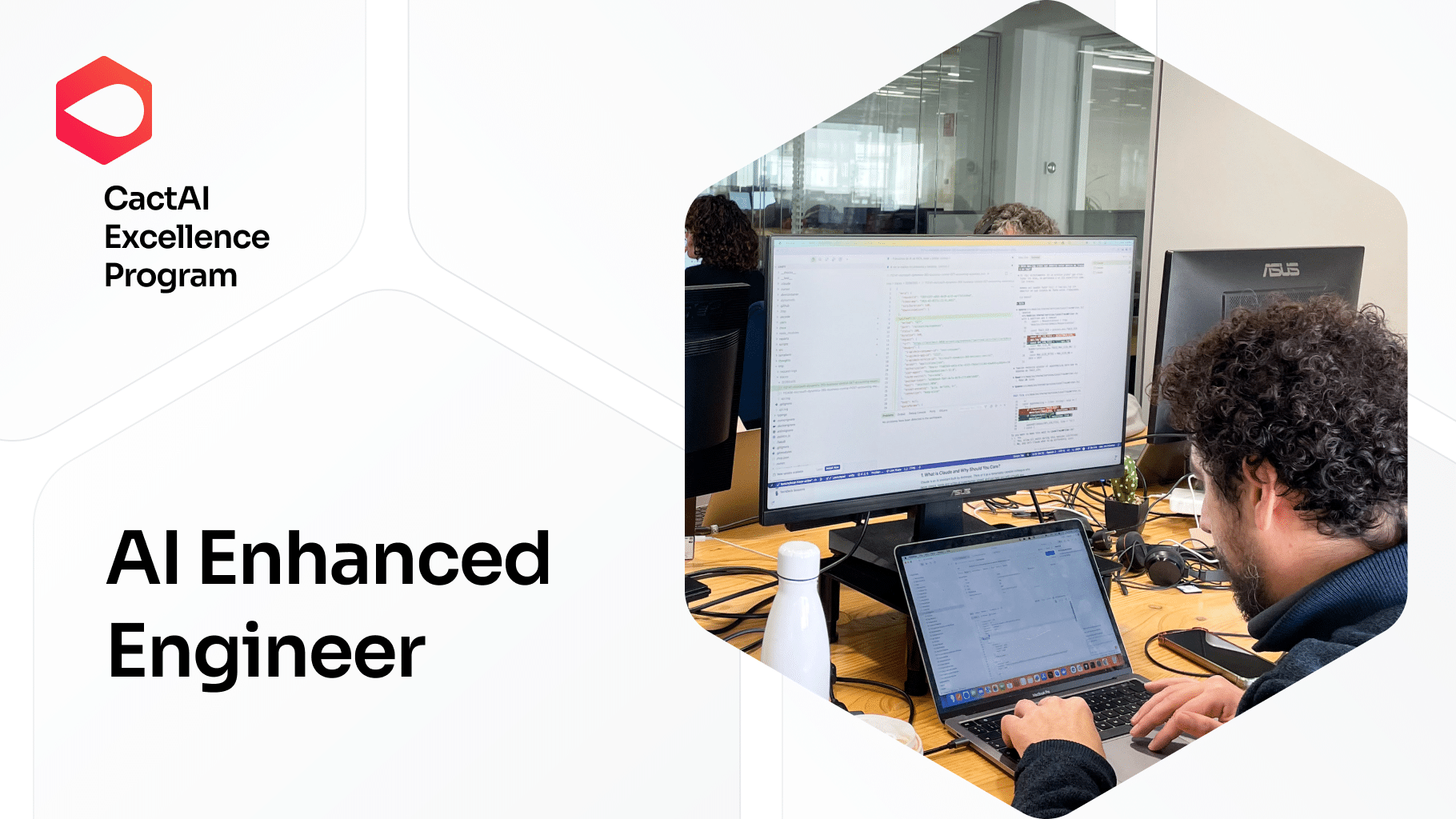
The CactAI Excellence Program is our answer to that ambition. Designed specifically for software engineers, AI product engineers, and QA engineers at Cactus. We have structured around 50-hour certification journey that takes participants from foundational AI literacy all the way to building and defending a real-world AI-powered feature. This article explains why we built it, what’s inside, and what it means for the future of how we ship software at Cactus.
The gap between using AI and engineering with it
Modern AI tools are impressively accessible: fire up a coding assistant, paste in some code, and watch something useful come out. But that accessibility can be deceptive. It creates the illusion of competence without the underlying understanding needed to build reliable, safe, and cost-efficient AI-powered software.
-
Engineers who haven’t internalized how LLMs work struggle to debug subtle failures, hallucinations, context drift or inconsistent outputs that appear randomly and are hard to reproduce.
-
Without governance knowledge AI features ship without proper guardrails, exposing organizations to data leakage, prompt injection and compliance risk.
-
Teams that evaluate models by «feel» rather than structured metrics spend more time arguing over quality than shipping product.
-
AI features that seemed straightforward in prototyping often fail in production because of overlooked infrastructure concerns: latency, cost, observability and failure modes.
«The context of coding has completely changed. Every role involved in building software needs to adopt an AI-First mindset not just developers but the entire engineering organization.» – Jose Laffitte, Head of Engineering at Cactus.
The opportunity, on the other side of that gap is significant. Teams that deeply understand AI design smarter integrations, catch errors before production and make architectural decisions rooted in real knowledge rather than assumption. They’re faster to experiment, more confident in deployment, and more equipped to spot when an AI approach is actually the wrong tool for the job.
What AI-fluency actually requires
The CactAI Excellence Program was built on a clear-eyed view of what it takes to work confidently at the intersection of software engineering and modern AI. It covers three interconnected domains, each essential to the full picture:
-
Conceptual depth: Understanding the actual mechanisms behind AI. How transformers process context, how embeddings encode meaning, how models are trained versus how they’re used at inference time and gives engineers a mental model that makes every other part of the program stick. Best practices feel inevitable when you understand why they exist.
-
Responsible engineering discipline: AI systems introduce failure modes with no equivalent in traditional software. Ethics, governance, and security are treated here as core engineering competencies, carrying the same weight as performance or reliability. Prompt injection, hallucination mitigation, data leakage prevention, and human-in-the-loop design patterns are all first-class topics.
-
Production-grade integration patterns: RAG architectures, vector databases, orchestration frameworks, function calling with typed contracts, LLMOps observability. The program grounds participants in the infrastructure and patterns they’ll actually encounter when shipping AI features at Cactus.
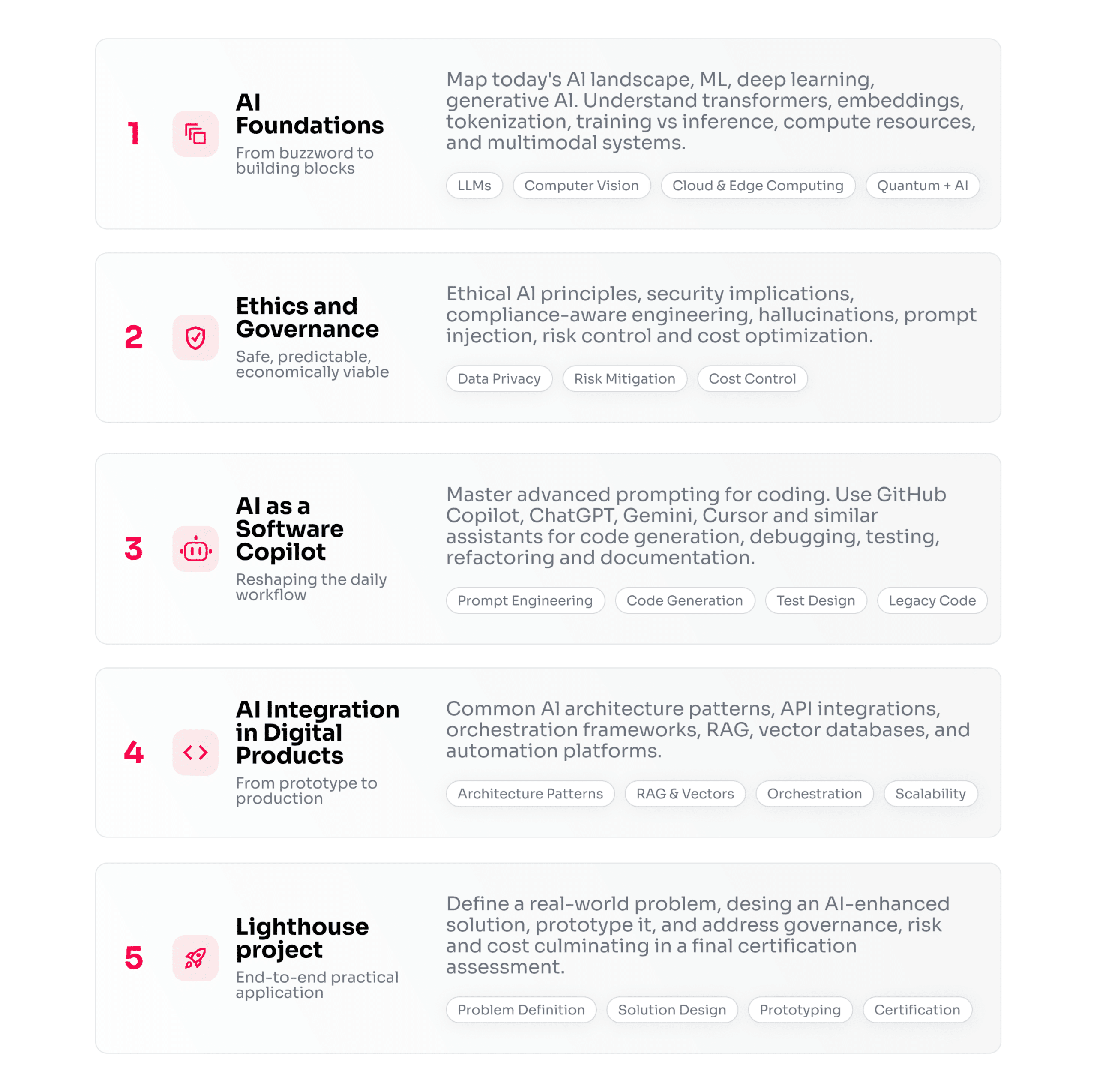
Five modules. One mission.
The program is structured as a progressive journey across five modules, each building directly on the previous one. By the end, participants will have covered the full arc of the craft: conceptual grounding, responsible engineering, daily tooling, production integration, and a real shipped feature they can defend.
The engineers behind CactAI
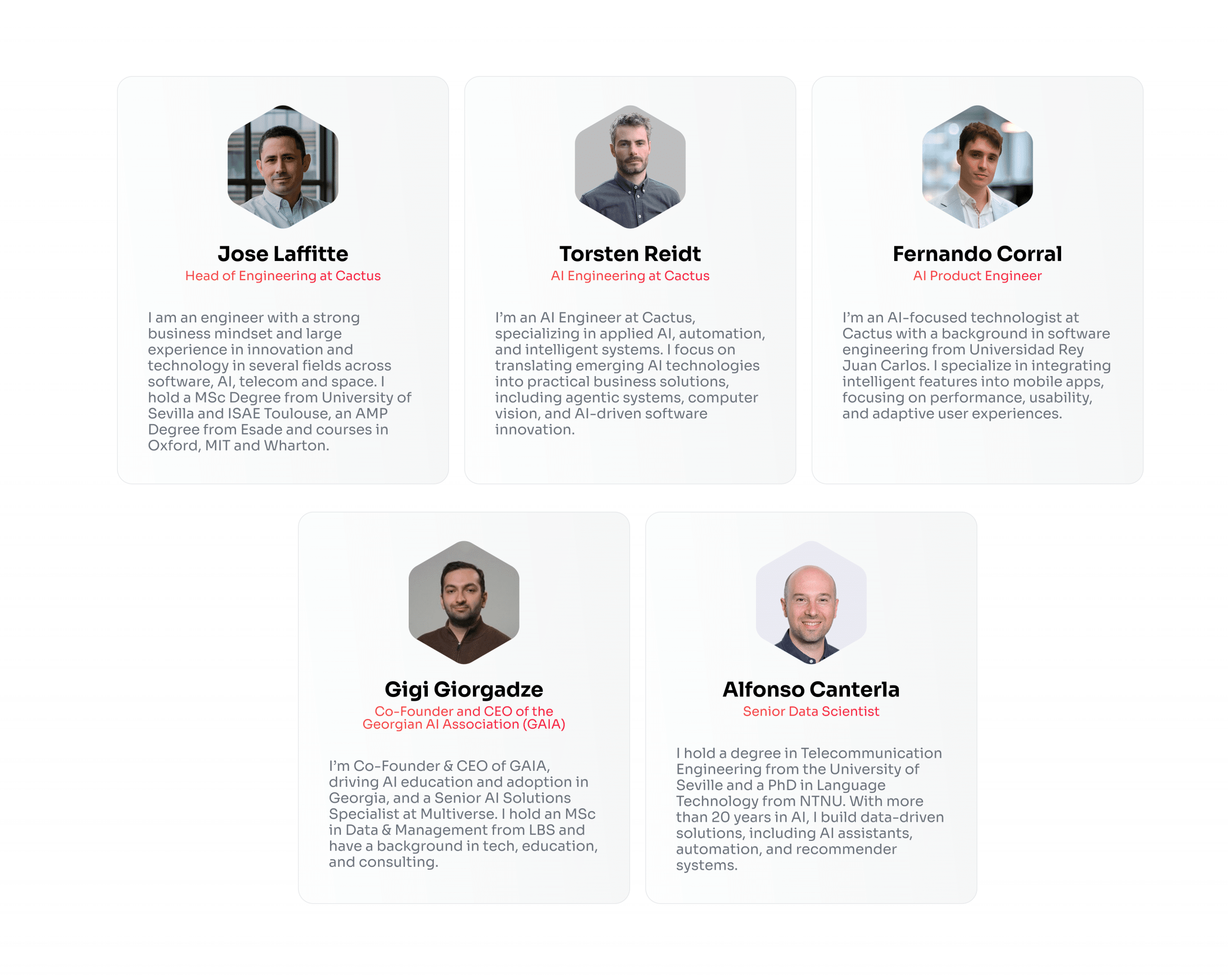
The program was designed and is taught by a team of engineers and specialists who work with AI in production every day. Their backgrounds span software architecture, applied AI research, mobile development, data science, and AI governance , which is precisely why the curriculum reads like field knowledge rather than a textbook.
What participants gain from this program
A strong foundation in AI and LLMs, hands-on experience with copilot workflows and production integration patterns, the knowledge to govern AI responsibly and a certified working AI project you built and defended yourself. Most importantly: the confidence to engage with AI meaningfully and contribute to the innovation happening within the software industry.