At Cactus, innovation has always been rooted in practical impact. As the company continues to grow, the need for a clear, consistent, and efficient onboarding process is been more relevant. New employees are welcomed with a large amount of information from HR documentation to IT guidelines, and it’s easy for them to feel lost or unsure where to find answers.
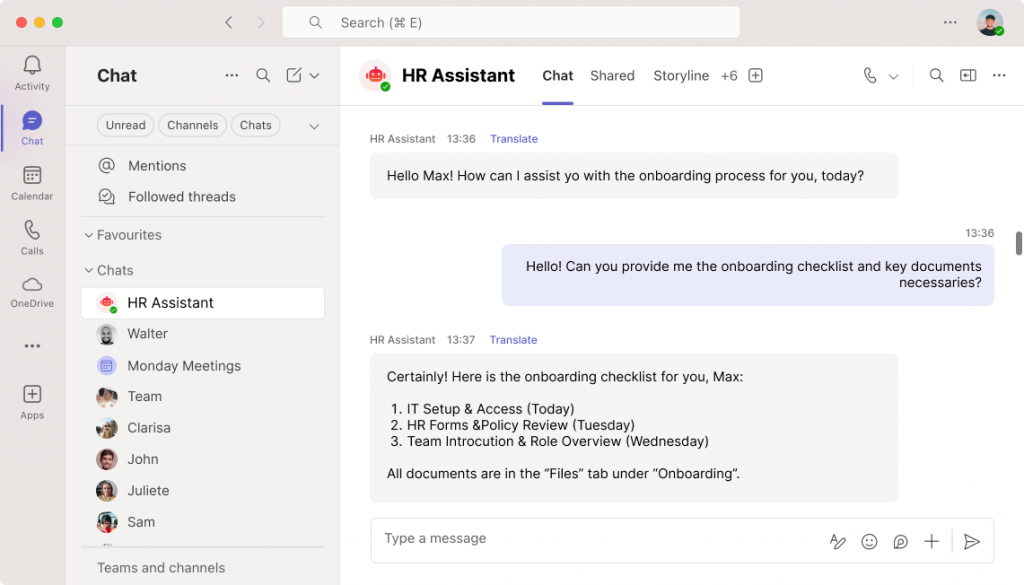
To address this, Cactus developed an AI-powered chatbot inside Microsoft Teams with a simple purpose: help employees access information quickly, reduce repetitive questions for HR and IT, and ensure that knowledge is always within reach.
The Challenge & Opportunity
Simplifying information access
Newcomers often forget where documents are stored or struggle to locate internal procedures. As a result, HR and IT frequently need to resend the same materials or answer questions already covered in existing guides. This slows down onboarding and creates unnecessary workload for support teams.
A better way to onboard
The chatbot creates a more efficient, AI-supported onboarding experience by:
Making information instantly accessible, right inside Microsoft Teams.
Reducing dependency on HR and IT for routine questions.
Empowering employees to find answers independently.
Using AI to combine smart search with early process automation.
Optimizing internal workflows across departments.
The chatbot supports a smoother, more confident onboarding journey and lays the foundation for broader internal efficiency.
The Technological Foundation
The Cactai’s development team designed a layered technical framework that combines advanced AI with structured data processing.
1. Microsoft teams integration
The chatbot is installed as a native Teams application, offering access to every employee without introducing new tools.
2. Smart knowledge retrieval
The bot’s backend connects to multiple data sources, currently starting with Confluence but designed to expand to files, third-party sites, or any internal data store.
Information is indexed as vectorized data, allowing semantic search instead of simple keyword matching.
3. Large Language Model (LLM) Intelligence
At the core sits a ChatGPT-based model enhanced by:
Semantic search (vector database)
Keyword-level search (to reinforce accuracy)
Context-aware question processing
This combination ensures the chatbot can interpret natural language, fetch relevant information, and respond with clear, accurate answers based on company documentation.
4. Conversation management
Users can issue commands such as:
“Show me what you know” – displays available knowledge sources
“Reset conversation” – clears memory to avoid context confusion when switching topics
This ensures more reliable conversations and prevents AI responses from blending unrelated subjects.
Solution & Real-World Impact
Routine support tasks that once took their time to HR or IT are now handled automatically. The chatbot can guide users through procedures, provide documents on demand, and ensure consistency in the answers given across the company.
The bot is also evolving into a tool that can perform simple operational tasks. One upcoming feature will allow authorized users to trigger invoice creation in the Tempo system directly from Teams. Another recently added feature automatically notifies HR when employees have not correctly filled their monthly hours, a task that previously required manual checking.
The Future & Conclusion
Looking ahead, the chatbot will continue to grow with more knowledge sources, improved context handling, and new automations. The long-term vision is a unified internal assistant that supports multiple departments.
By making information easy to access and automating repetitive tasks, Cactus is building a more efficient work environment.